Bleeding in Silence - Women in Gaza Fighting a Silent Battle Amid a War
This article has been researched and compiled from various internet sources by Akshita Nannapaneni for the stocktherooms.org initiative. - August 2025
Of the 800 million women that menstruate every day, 700,000 Palestinian women are struggling to get access to necessary hygiene items: menstrual products. The war between Israel and Hamas has forced Palestinian women into an impossible situation. “Sometimes I need pads and soap m
ore than I need food,” explains Aisha*, a young girl forced to live in a crowded displacement tent, with limited access to basic hygiene and almost no access to menstrual products.1
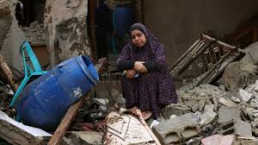
Israel imposed several blockades onto the Gaza Strip from October 9 of 2023. Though the first few blockades partially allowed aid to enter Gaza, the re-imposed blockades from March 2, 2025 have been stricter. These actions have caused severe depletion of basic hygiene necessities such as soap
and clean water including menstrual products, preventing women and young girls from accessing menstrual products. Since the war began goods such as hygiene products have become very expensive, that is if they can be found at all. The situation is so terrible that menstrual hygiene, a basic fundamental health need, has become the afterthought amid the humanitarian crisis.
Along with the daily nightmare of the war, menstruators have to face the horror of having no products to aid them with their natural bodily functions, forcing them to resort to using torn and dirty rags and dried leaves. Due to lack of alternatives, many are left with no choice but to engage in these unhygienic practices which can cause various health risks like infections and toxic shock syndrome which can be life threatening in severe cases. 2
With 1.9 million people, making up 90% of the Gaza Strip’s population displaced, people are forced to live in makeshift tents, leaving women with little to no privacy at all, making general hygiene very hard and menstrual hygiene even more tough to maintain.

Since survival is the main focus, menstruating with dignity is no longer a concern. This can lead to girls often feeling shame and fear when they get their period, especially in crowded shelters where there is little privacy. The lack of access to menstrual education only increases the emotional
distress. “Food keeps us alive, but pads, soap, and privacy let us live with dignity,” said Maysa*, a displaced, suffering woman in Khan Yunis. “When we receive hygiene kits, it feels like someone finally sees us.”3
The psychological impact can be immense, with women and girls already dealing with trauma from displacement, loss of loved ones, and fear for their lives. The stress of managing menstruation without proper resources only adds to their suffering. Sometimes the psychological trauma is so severe that many women and girls stop menstruating altogether. This is a biological response to the extreme levels of stress, fear, anxiety and deprivation that they endure daily.
Menstrual hygiene is not a luxury, it’s a human right. Yet in times of crisis, it is frequently overlooked in humanitarian response planning. Distributing menstrual products, providing access to clean running water and sanitation, and including menstrual needs in aid packages are not optional, but are essential.
Ignoring menstrual health in Gaza continues the inequality and undermines the dignity and well-being of half the population. Menstrual equity must be recognized as a critical part of any humanitarian response, as the international community continues to mobilize aid for Gaza, menstrual hygiene needs to be part of the conversation. This is not just a women’s issue, it’s a human rights issue, and in Gaza, it’s one that can no longer be ignored.
Organisations like the United Nations Population Fund (UNPF), Heart to Heart International and Anera are supplying hygiene kits which contain pads, soap and other essential items. Though these kits are being distributed they are simply not enough.
Raising awareness and challenging restrictions caused by beliefs is crucial to empowering women and girls to manage their periods comfortably. This includes providing access to affordable and sustainable menstrual products, educating people about menstrual health and making sure the humanitarian aid in Gaza prioritizes menstrual health. Alongside all of these, boycotting goods of companies that fund Israeli businesses, such as Procter & Gamble which produce “Always Pads”, “Tampax” tampons and other products and instead supporting local and women owned businesses is a great way to help people struggling in Gaza. By including all of these into relief efforts we uphold the health and dignity of women and girls even in the most challenging conditions.
1*Names Changed for privacy and protection
* Names changed for protection and privacy
Sources
Works Cited
“Advocacy Brief - Silent Struggles: The Menstrual Hygiene Crisis in Gaza (May 2025) - occupied Palestinian territory.” ReliefWeb, 1 June 2025, https://reliefweb.int/report/occupied-palestinian-territory/advocacy-brief-silent-struggles-menstrual-hygiene-crisis-gaza-may-2025 . Accessed 24 July 2025.
Ayyoub, Aber. “As war in Gaza drags on, crucial female hygiene products run out.” 24 August 2024, https://www.al-monitor.com/originals/2024/08/war-gaza-drags-crucial-female-hygiene-products-run-out. Accessed 24 July 2025.
Bashir, Abu Bakr. “Another layer of misery: Women in Gaza struggle to find menstrual pads, running water.” NPR, 11 January 2024, https://www.npr.org/sections/goatsandsoda/2024/01/11/1224201620/another-layer-of-misery-women-in-gaza-struggle-to-find-menstrual-pads-running-wa. Accessed 28 July 2025.
Eid, Shaimaa, and Abdallah Aljamal. “Menstrual Cycles - A Silent Nightmare for Displaced Women in Gaza.” Palestine Chronicle, 19 June 2025, https://www.palestinechronicle.com/menstrual-cycles-a-silent-nightmare-for-displaced-women-in-gaza/. Accessed 24 July 2025.
“From natural process to nightmare: How Gaza's women and girls cope with their periods in a war zone.” United Nations Population Fund, 2 June 2025, https://www.unfpa.org/news/natural-process-nightmare-how-gaza%E2%80%99s-women-and-girls-cope-their-periods-war-zone. Accessed 24 July 2025.
“Gaza: Women and girls struggle to manage their periods amid crisis.” 8 June 2025, https://news.un.org/en/story/2025/06/1164081. Accessed 24 July 2025.
Heart to Heart International. “Delivering Essential Supplies to Women and Girls in Gaza.” Heart to Heart International, 30 June 2025, Delivering Essential Supplies to Women and Girls in Gaza, https://www.hearttoheart.org/delivering-essential-supplies-to-women-and-girls-in-gaza/ Accessed 24 July 2025.
“Palestine.” UNFPA Palestine, 28 May 2025, https://palestine.unfpa.org/en/sexual-reproductive-health . Accessed 24 July 2025.
“Provide pads and hygienic supplies to Gaza.” Anera, https://support.anera.org/a/pads-4-gaza. Accessed 28 July 2025.
Roy, Sara, and Sari Bashi. “Blockade of the Gaza Strip - Wikipedia.” https://en.wikipedia.org/wiki/Blockade_of_the_Gaza_Strip. Accessed 24 July 2025.

Comments